


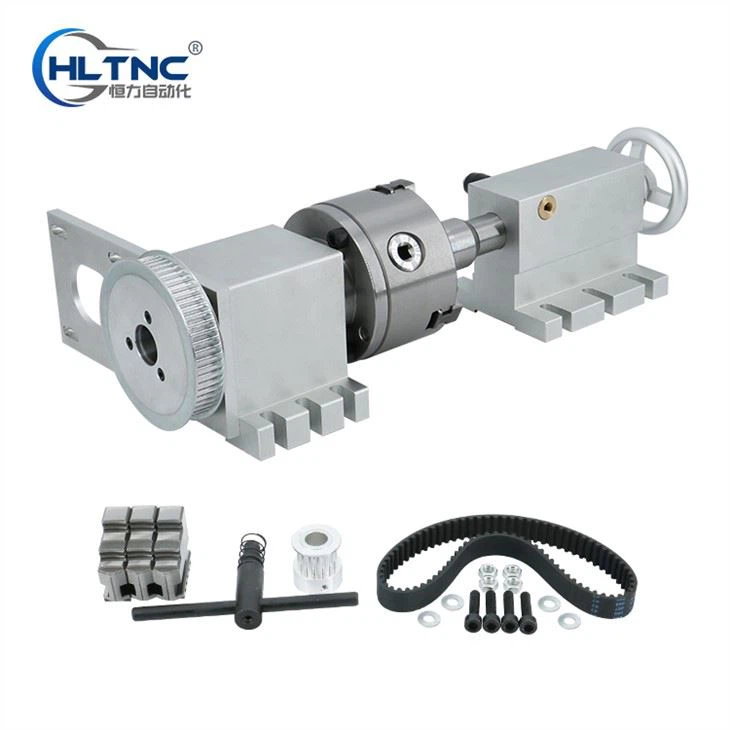


4th Axis
Product Introduction: 4th axis
In order to effectively process complex workpieces, it is often necessary to utilize circular feed motion with multiple axes such as X, Y, and Z. To achieve this, a vertical machining center can be equipped with a fourth axis, typically in the form of a CNC rotary table. The rotary table is capable of both forward and backward movement, allowing for versatile arc and curved surface processing in conjunction with linear feed. Additionally, the CNC rotary table is able to achieve precise automatic indexing, further enhancing its usefulness in machining applications.
The 4th axis is a versatile component that allows for feed indexing and circumferential feed movement. The former refers to the ability to rotate or position the workpiece up to 360° during non-cutting phases, while the latter pertains to feed movement in the worktable's circumferential direction. By linking the three coordinate axes of X, Y, and Z together, complex curved surfaces can be processed, making box parts much easier to handle. A CNC rotary table is now an essential feature for any vertical machining center with automatic tool change and multi-process centralized processing.
Technical requirements for the fourth axis
To achieve optimal performance, it is essential to ensure that the journal and fourth shaft are precisely aligned and maintain a suitable clearance. It is crucial to establish a close and even contact between the two components, allowing for smooth operation and durability.
The contact angle plays a crucial role in the interaction between the journal and the fourth shaft. It is important to find the right balance for the contact angle, ensuring it is neither too large nor too small. When the contact angle is too small, there is an increase in pressure on the fourth axis, which can lead to significant deformation and accelerated wear, ultimately reducing its service life. On the other hand, if the contact angle is too large, it hinders the formation of an effective oil film and prevents proper liquid lubrication. Therefore, maintaining an optimal contact angle is essential for the longevity and performance of the system.
When assessing the scraping quality of the fourth axis, one important factor to consider is the number of contact points between the journal and surface. A higher number of contact points per unit area indicates finer and more uniform scraping, whereas a lower number indicates poorer scraping. It's worth noting that finer contact points tend to be more difficult to achieve through scraping and grinding. Therefore, the quality of the fourth axis scraping is directly related to the density and uniformity of the contact points.
Product Specification


Our Company


Packing, Storage, Handling and Transportation


Hot Tags: 4th axis, China 4th axis manufacturers, suppliers, factory
Previous
Clamping Kits and PartsYou Might Also Like


Send Inquiry